“I really like it when you call a family and they're like, ‘You get it,’” enthusiastically shares Mason City Child Health Specialty Clinic Family Navigator/FPSS Jackie Schott. “‘My friends don't understand, my parents don't understand, but you understand because you're where I am or have been where I am.’”
The team of Family Peer Support Specialists (FPSS), known internally as Family Navigators (FNs) at Child Health Specialty Clinics (CHSC), are parents or primary caregivers of children with special health care needs. Drawing on their lived experience, FNs provide emotional support, help families navigate complex systems, and connect them to community resources.
The Iowa Peer Workforce Collaborative (IPWC) trains Family Peer Support Specialists. Three IPWC FPSS trainers also work as CHSC Family Navigators: CHSC Carroll Clinic FN/FPSS and Program Coordinator Rachel Charlot, CHSC Iowa City FN/FPSS Renee Speh, MSW, and CHSC Mason City FN/FPSS Jackie Schott.
Oelwein Clinic FN/FPSS and FN/FPSS Network Coordinator Sharon Rettinger continues describing how personal lived experience informs their profession, “I would say fundamentally it guides all our work. We meet people where they're at, and so we want to not only share resources that we know of with them, but we provide that emotional support. That's probably the most important piece.”
Child Health Specialty Clinics (CHSC) is part of the University of Iowa Division of Child and Community Health and the Stead Family Department of Pediatrics. CHSC staff members provide Iowa’s children and youth with special health care needs, and their families, the opportunity to participate in gap-filling clinical care, health assessments, care coordination, and family-to-family support. In addition to FNs, clinic teams include Advanced Nurse Practitioners, Registered Nurses, and sometimes, Registered Dietitians. CHSC, with central offices in Iowa City, is strategically structured to empower families with accessibility to services through 13 regional centers, additional satellite clinics, and telehealth options.
Iowa City FN/FPSS Renee Speh, MSW, describes topics that may be discussed during interactions with families, “Checking in with them and seeing what their top priorities are, what their concerns are, their questions, and helping them figure that out, offering that family-to-family support. If they have other issues, I can help them try to figure out what resources they need or some strategies they can do to deal with those concerns.”
When Speh shares a nugget of her own family’s journey with another family, she observes, “Then, they’re, I think, more relaxed, and they feel like they can tell me all those things that they're embarrassed about and get some support. And I can talk about some things that were helpful for our family that might be helpful for their family. No matter what experiences a family has had, we can still connect because we get how it is, you know, to raise a child with special health care needs. And so, there's that connection, no matter what other differences there may be.”
Carroll Clinic FN/FPSS and Program Coordinator Rachel Charlot explains part of her job involves stepping outside the office, “I travel to homes, typically with the Area Education Agency, and sit through those home visits and talk to families about their resources and needs and information or additional support.” Charlot describes the benefit that her own lived experience brings to her role, “Trying to bring things down to the simplest terms without a lot of language or a lot of acronyms is one thing that I think our lived experience really brings to the table. Our inherent power, as we call it in FPSS training, is really listening and that power of ‘me too, I've been there.'"
FNs are also an integral part of CHSC’s commitment to promoting family leadership and connection through trainings and opportunities for engagement. One example of this work is the Iowa Family Leadership Training Institute (IFLTI), a program for parents and caregivers of children or youth with special health care needs. Charlot expands on elements of IFLTI, “We provide a four-month-long training program on helping them to build their advocacy skills and knowledge of the system. We teach them how to work with partners, things like, how do you communicate with individuals you maybe disagree with? Or how to understand your place in the system? Who are you as a leader? What are your personal strengths?”
The CHSC FN team members emphasize the importance of enhancing their own skills and knowledge through consistent team meetings. Rettinger describes how ongoing training and learning equips the FNs to most effectively support Iowa families, “If you think about the system - the education system, social systems, judicial system, and the health care system – are all evolving, changing constantly. I feel like, without constant trainings, how would we be aware of what all is out there?”
Charlot points out the strengths-based sharing among FN team members, “The support that we provide to one another when we're having a struggle or an issue, you know, ‘who has experienced this?’ or ‘what additional resources could I be thinking about?’ And that's something CHSC provides a lot of space to do, which is excellent.”
And the CHSC FN team recognizes they are part of a legacy that other states look to as a model. As Rettinger notes, “In 1984, Child Health Specialty Clinics hired their first Family Navigator, who was Julie Beckett. Iowa has a really long history of recognizing, embracing, and supporting the principles of family and professional partnership.”
Schott sums it by recalling conversations with Family Peer Support Specialists from other states throughout the country, “I’ve been at national conferences, and Iowa is the gold standard for family navigation, for the system we have. They’re like, ‘you guys are the top,’ so that is a really good compliment.”
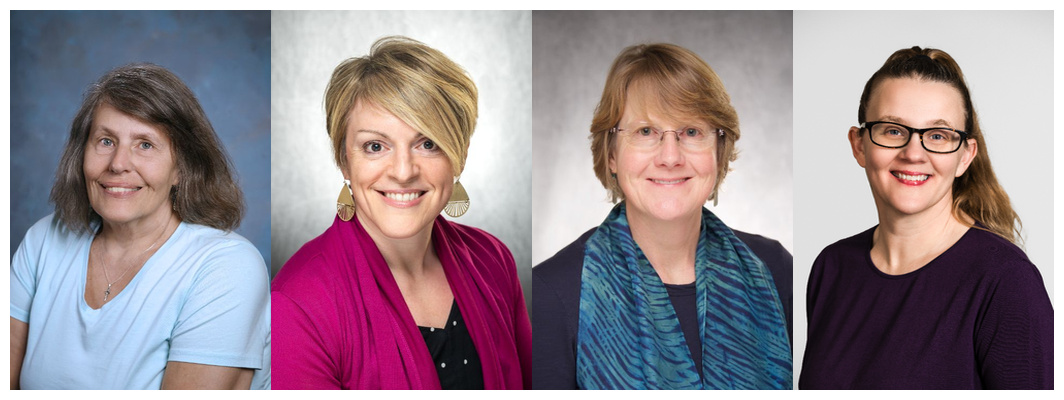
CHSC Family Navigators/Family Peer Support Specialists pictured above from left to right: Sharon Rettinger, Rachel Charlot, Renee Speh, and Jackie Schott.